Technology & Tools
Barbershop Software: What You Actually Need to Run Your Shop
Shops running on disconnected software lose five to ten hours a week to admin work that a connected system handles automatically. That's from SQUIRE's 2026 State of Barbershops report. It tracks with what owners say when you ask them where their time actually goes.
The problem isn't that the tools don't exist. Booking apps, payment processors, client management software, reporting dashboards: all of it exists and most of it works. The problem is that most shops run them separately, which means the data doesn't connect and someone manually bridges the gaps every week.
If you've heard the argument that a booking app alone won't run your barbershop, here's the next step: what each category of software should actually do, what to look for when evaluating options, and how to know when you've got a stack that runs together.
See how SQUIRE connects booking, payments, and reporting for barbershops.
Online Booking and Scheduling
Most shops already have a booking link. The question is whether that booking setup is actually working, or just existing.
Booking software that only lets clients schedule appointments isn't doing most of the work it could be doing.
What The Best Barbershop Booking Software Actually Handles
Client-facing booking from everywhere they find you. Your link in bio is one entry point. But clients also search for barbershops on Google, find shops through Instagram Reels, and increasingly ask AI tools where to book. Booking software that only works through one link misses the others. Look for direct integration with Google Business Profile and Instagram, so a client who finds you through either can book without leaving the platform.
Real-time calendar updates across every barber. When a client books online, that slot should disappear from every barber's available time instantly. If your booking system runs a few minutes behind, you'll deal with double-books. If it updates manually, you'll deal with it constantly.
No-show protection built into the booking flow. A deposit or card-on-file requirement at booking doesn't chase clients away. It filters for ones who show up. Shops that require a card at booking see a meaningful drop in no-shows. The best booking software makes this part of the standard flow, not an afterthought setting buried in admin.
Walk-ins without friction. Online booking handles the clients who plan ahead. Walk-in management (a waitlist, a kiosk, a way for walk-ins to join the queue without disrupting the barber mid-cut) is a different workflow, and it matters just as much on a busy Saturday.
The right booking system handles both. If yours only does one, you're building a workaround every weekend.
Payments
General payment processors were built for retail and restaurants. They work, but they weren't built for a shop where checkout happens at the chair, tips are a meaningful part of each barber's earnings, and half your clients didn't book ahead.
The question to ask about any payment system isn't "does it process cards?" Every app does. The questions that actually separate a barbershop-ready payment system from a general one are more specific.
Does checkout work on a mobile device, mid-conversation, without a countertop terminal? Does the system track tips by barber automatically, or does reconciliation fall on you at the end of each shift? Can a walk-in client pay without a booking reference attached to the transaction? Does the platform offer same-day payouts, so barbers don't wait three business days for earnings they worked for today?
If the answer to any of those requires a workaround, the payment tool wasn't built with a barbershop in mind.
For the full breakdown of what to look for, and what most shops get wrong when they evaluate a POS, see Best POS System for Barbershops: What to Look For.
AI Tools for Barbershops
AI in a barbershop context means one thing: handling the moments when you're in the chair and can't respond.
You can't answer a call mid-fade. You can't manually re-engage every client who hasn't booked in six weeks. You can't stop a service to pull last month's revenue by barber. But those things need to happen, and when they don't, revenue leaks out slowly: a missed booking here, a lapsed client there, a report you never ran because building it took too long.
AI tools for barbershops don't replace the people in your shop. They cover the gaps between them.
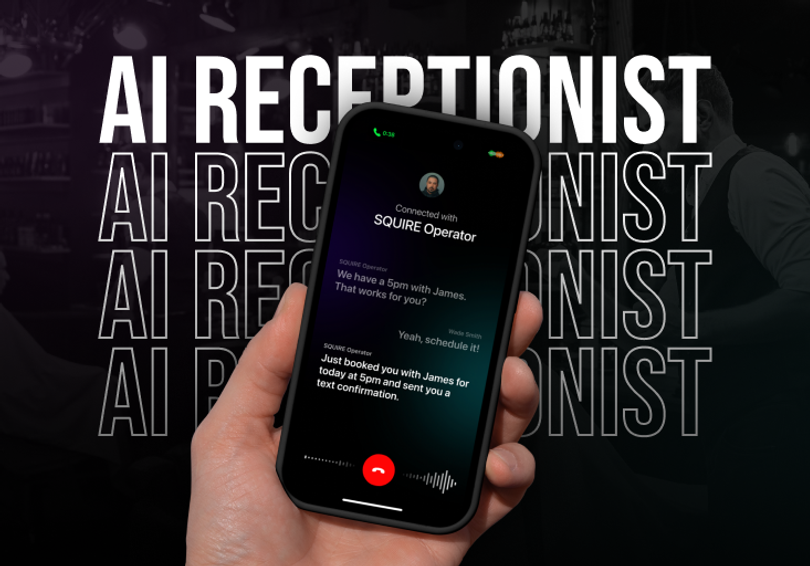
Call answering and booking. Operator powered by SQUIRE AI answers your shop's incoming calls 24/7. It books appointments from your live calendar, handles common questions, and passes a summary to your staff. Clients get an answer. Missed calls stop becoming missed bookings. For the full breakdown on how AI call handling works and what to expect from it, see AI Receptionist for Barbershops.
Client re-engagement. Engage powered by SQUIRE AI identifies clients who haven't come back and re-activates them through targeted messages based on how long they've been away, what services they've booked, and what's likely to bring them back. The campaigns run automatically. You set the criteria; the system does the outreach.
Data on demand. When you want to know how last month compared to the one before, or which barber is driving the most rebooking, you should be able to ask directly, not export a spreadsheet and figure it out manually. Reporting Assistant powered by SQUIRE AI answers plain-language questions about your shop data in real time.
For how AI fits into a modern barbershop management system, see From Hustle to Mastery: The Modern Barbershop Management System.
Client Management
Every barber knows their regulars. The fade they always get, the family they ask about, the preference for a little more off the sides. That knowledge lives in your head. When it lives in your software, it travels.
Client management software is what turns appointment history into a relationship you can build on.
Client profiles and notes. Every booking should add to a client's record automatically: what they got, who cut them, any notes from the appointment. When a regular comes back, the barber should be able to pull that context without asking the client to remind them. When a new barber takes over a chair, the history transfers.
Rebooking at checkout. The easiest rebooking moment is the one right after the cut, when the client is happy and the chair is still warm. Software that prompts rebooking at checkout (or automates a reminder a few weeks later) turns single visits into recurring revenue without anyone having to manually follow up.
Loyalty that runs itself. A loyalty program that tracks visits and rewards clients for coming back doesn't require a punch card or a staff member managing it. It runs in the background and gives clients a reason to choose your shop over the one down the street.
Cross-link to the Client Retention hub coming once that pillar launches. In the meantime: client management and loyalty program feature pages.
Reporting and Analytics
Most barbershop software shows you what happened. A transaction log. An appointment list. A payout total at the end of the day.
That's a record. It's not reporting.
Reporting is what tells you what to do about what happened. And the gap between those two things (between having data and being able to use it) is where most shop owners lose ground.
The first step is having data that's accurate and complete, which requires your booking, payments, and client records to be in one system. The second step is being able to access it without building a custom dashboard or running an export every time you have a question.
That's where AI changes the picture. Reporting Assistant powered by SQUIRE AI answers plain-language questions about your shop data in real time: which barber had the highest rebooking rate last month, what your revenue looked like on the last four Mondays, where this week sits against the same period last year. You ask; it answers.
One area worth pulling your own data on before making any staffing or scheduling decisions: when your shop is actually busiest. SQUIRE data from thousands of shops shows that peak demand patterns have shifted significantly. The hour you think is your rush may not be the one your booking data reflects. For the full breakdown, see The 5 O'Clock Cut Is Gone: What Barbershop Peak Hour Data Actually Shows.
How to Evaluate Barbershop Software (and Switch When You're Ready)
There's no shortage of booking apps, payment tools, and management platforms aimed at barbershops. Most of them were built for salons, spas, or fitness studios and adapted for barbers. A few were built for barbershops from the start.
The difference shows up in the details: whether tip splits are automatic or manual, whether checkout works at the chair or only at a counter, whether the AI tools understand barbershop-specific call scenarios or give generic answers.
The questions worth asking before you commit to a platform:
Is everything connected? Booking, payments, client data, staff management, and reporting should all live in the same system, or integrate so cleanly that they function as one. If moving between features requires switching apps, you're going to lose data and time at the handoffs.
Was this built for barbershops or adapted for them? Ask specifically whether the product handles chair-side checkout, walk-in flow, tip attribution, and booth rental or commission splits. If the answer requires a workaround, that's a signal about what else will require one.
What does migration actually involve? Switching platforms sounds more disruptive than it usually is. Most shops can move to a new platform in about 21 days without losing client history, going dark on bookings, or confusing staff. The process is a logistics problem, not a technical one, and a platform worth switching to should have a migration team that handles it.
For the complete 21-day migration playbook, see How to Switch Barbershop Booking Software Without Disrupting Your Shop.
FAQs
12 articles found. Page 1 of 1.
Articles

The Barbershops That Own Their Booking Experience Keep More Clients
August 26, 2026
If Your Barbershop Software Can't Answer These Questions, It's Not Doing Its Job
August 21, 2026
When Your Booking App Stops Working for Your Barbershop
August 19, 2026
The Business Model Behind Your Barbershop Booking App
August 12, 2026

Barber and Cosmetology Schools Are Adopting AI. Here's What Shop Owners Can Learn.
July 13, 2026
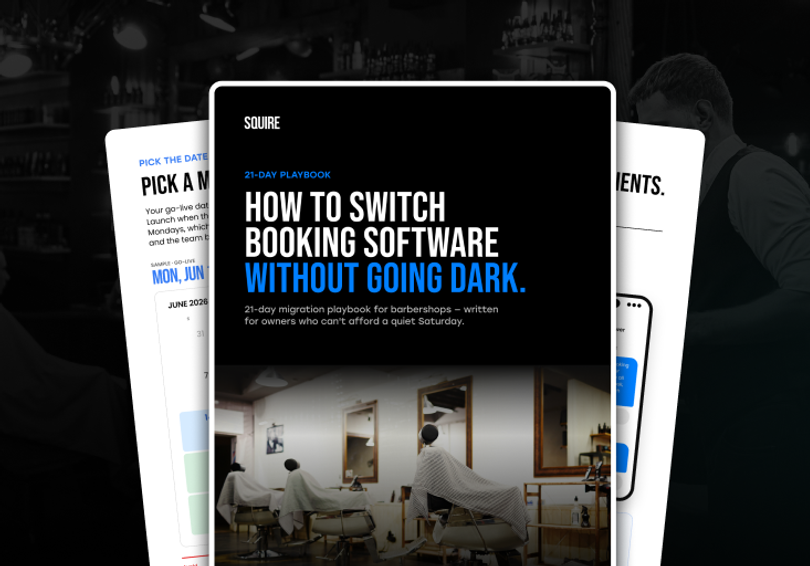
How to Switch Barbershop Booking Software Without Going Dark
July 1, 2026
AI Receptionist for Barbershops: What Actually Works (and What Just Pretends To)
June 19, 2026
The Modern Barbershop Management System: From Hustle to Mastery
June 17, 2026

Introducing SQUIRE AI
August 11, 2025
What's New with SQUIRE - April 2025
April 2, 2025
Are Marketplace Apps Good for Barbershops? 4 Ways They Limit Your Growth
August 10, 2023
Barbershop Management Software: Why a Booking App Isn't Enough to Run Your Shop
January 21, 2023