


Client Retention & Loyalty
Barbershop Client Retention: The Complete Guide for Shop Owners
Barbershop clients stop coming back because nothing brings them back. Most had no complaint about the cut. They drift when no one prompts the next visit. Barbershop client retention is the system that closes that gap in four stages: win the second visit, protect the appointment, make them a regular, and win back the drifted. This guide covers all four.
A client on a four-week cycle books 13 appointments a year. The average client in the State of Barbershops 2026 report gets about seven haircuts a year, and returning clients wait 48.5 days between visits. Closing part of that gap is what retention does, and it starts in the weeks after the first visit.
This guide is for shop owners and operators who want one place to see how retention works, then go deeper where their shop leaks. Each stage gives you the framework and the decisions that matter. The linked guides carry the scripts, the setup steps, and the full data.
Short on time? Start with the stage that matches your problem. See how SQUIRE supports client retention from booking through loyalty.
Last updated: November 2026
Why do barbershop clients stop coming back?
Clients mostly drift away. They leave happy, nothing prompts them to rebook, a few busy weeks pass, and another shop fills the gap. Each client who drifts takes their future repeat visits with them. The cause is a missing system, and a missing system can be fixed.
Drift is quiet
A client leaves with a fresh cut. Three weeks pass with no reminder and no reason to rebook. They walk past a closer shop on the way to work or see another barber on Instagram. Nobody decided to leave. Nothing pulled them back.
What the numbers say
The State of Barbershops 2026 report puts three numbers on it:
- 44.63% of all visits come from a client who has been to that shop before.
- Returning clients wait an average of 48.5 days between visits.76% of clients rank booking convenience equal to service quality, according to industry research cited in the report.
Shave a week off that gap and the math changes: 365 days divided by 41.5 is about nine visits a year, with no new client added.” Showing the math makes it clearly derived, not a claimed stat.Source: State of Barbershops 2026 report, covering 13.9M appointments across about 7,000 U.S. shops, May 2025 to April 2026. The 76% figure is industry research cited in the report.
New clients can’t outrun drift
Replacing drifters with new clients is an expensive way to fill a book. Every client you keep also refers friends and leaves reviews, so retention makes every dollar you spend on new clients go further. That is why the fastest-growing shops in the State of Barbershops 2026 data focus on winning the rebook instead of running more ads.
Go deeper: why barbershop clients stop coming back has the full data and a five-part playbook, and why regulars matter more than a constant flow of new clients covers the trap of chasing new clients.
How does client retention work in a barbershop?
Client retention is the share of clients who come back after a visit. It runs as a four-stage loop: win the second visit, protect the appointment, make them a regular, and win back the drifted. Each stage fixes a different leak, so work them in order.
The four-stage loop
- Win the second visit. Get a first-time client to rebook before they have time to drift.
- Protect the appointment. Make sure booked clients show up, or that the chair refills when they don't.
- Make them a regular. Remember every client and give them a reason to choose your shop each time.
- Win back the drifted. Reach clients who slipped before the gap becomes permanent.
Stages one through three prevent drift. Stage four recovers what still slips through.
How to measure it
Track three numbers each month: the share of new clients who book a second visit, the average days between visits, and the share of your visits that come from returning clients. Together they show which stage is leaking.
- Few new clients rebooking points to Stage 1.
- Booked clients not showing points to Stage 2.
- Regulars thinning out after a few months points to Stages 3 and 4.
The Client Retention Report in Reports & Analytics shows who is returning and who needs a nudge.
Go deeper: the barbershop retention system breaks down the full retention system layer by layer, including how to set it up in SQUIRE.
How do you win the second visit?
Stage 1: Win the second visit
Ask for the rebook before the client leaves the chair, make booking the next visit take seconds, and let automation catch everyone who doesn't. The second visit is the tipping point, because clients who return once are far more likely to become regulars.
Ask at the chair
The end of the appointment is the best moment you will get. The cut is fresh, the client is satisfied, and the next visit feels like a natural extension of the one they just had. Make the ask an assumption: name an interval, such as four weeks, and offer the same slot. Most shops don't do this every time. The shops that do rarely have to chase anyone.
Make rebooking effortless
Industry research cited in the State of Barbershops 2026 report finds 76% of clients rank booking convenience equal to service quality, so the path to the next appointment matters as much as the cut. If rebooking means calling during business hours or sending a DM and waiting, you lose clients to shops where it takes two taps. Clients think about their next haircut at 11 p.m. on a Sunday. Your booking link should work then.
Let automation catch the rest
Some clients won't rebook at the chair, and you won't remember to chase every one. Smart Rebooking in Engage powered by SQUIRE AI learns when each client usually returns and texts them a nudge at the right moment. It covers the gap between the clients you asked and the clients who forgot.
Go deeper: Smart Rebooking in Engage 2.0 shows how it works and how to turn it on. The chair-side routine is in the barbershop retention system.
How do you reduce no-shows without losing clients?
Stage 2: Protect the appointment
Use three layers: automatic reminders so clients remember, prepayment or a card on file so the appointment carries weight, and a waitlist so an open chair refills itself. Tell clients your cancellation policy when they book, and follow up warmly after a miss.
What a no-show costs
Industry no-show rates run 5% to 15%, and a shop above 10% loses measurable revenue every month. A single miss costs the service price plus the tip, the rebook, any retail sale, and the time another client could have used. That typically adds up to $60 to $120, against $40 to $80 for the service alone. It also puts the relationship at risk, because how you handle the miss decides whether that client returns.
Three layers that prevent them
- Reminders and confirmations. Send them 24 to 48 hours ahead with the time, the barber, and a link to confirm or reschedule. Most no-shows are clients who forgot. Appointment reminders in SQUIRE go out automatically.
- Prepayment or a card on file. When a client pays at booking, the slot stops being a casual hold. Book & Pay collects payment upfront, and No-Show Protection applies your policy if a client cancels late or misses. Use it for everyone or only for higher-risk bookings: new clients, peak weekends, longer services, and anyone who has missed before.
- A waitlist. When a slot opens, the next client in line is notified and can claim it. The chair refills without a phone call.
Set the policy before you need it
Most shops ask for 24 to 48 hours of notice. Late-cancel fees commonly run 25% to 50% of the service price, and some shops charge more for no-shows. Tell clients at booking. A policy a client agreed to up front reads as a house rule, and one that appears after a miss reads as a penalty. A clear, fair policy mostly filters out the clients who don't value your time.
What to say when it happens anyway
Follow up the same day, keep it warm, and leave an easy way back. If a client misses a second time, tell them you'll need a card on file to hold their spot going forward. Silence does more damage than a friendly text.
Go deeper: what no-shows cost a barbershop has the full cost breakdown and a calculator. How to reduce barbershop no-shows covers setup for all three layers. A barbershop cancellation policy walks through writing yours, and what to say when a client no-shows has the word-for-word scripts.
See how No-Show Protection holds your schedule without the awkward conversation.
How do you turn a client into a regular?
Stage 3: Make them a regular
Remember every client, make the shop worth returning to, and give regulars a reason to choose you over the next shop. That means client history on every profile, a consistent experience from the door to the chair, and a loyalty program simple enough to explain in one sentence.
Know them before they sit down
The difference between a regular and a walk-in is whether your shop remembers them. Keep what they got last time, the products they use, any sensitivities, and one detail from their life worth asking about. Review the book before the day starts, two minutes per session, so the greeting is "same fade as last time, or switching it up?" instead of a blank "what are we doing today?" Keeping it in one place means it never depends on one barber's memory. Client management in SQUIRE holds notes, photos, and history on every profile.
Build the experience around the cut
Quality gets a client in the chair, and the experience around it brings them back. Acknowledge every walk-in within 30 seconds, even if it's a nod and "give us about fifteen." Keep the music and the space consistent so the shop always feels the same. Run walk-ins with a system clients can see is fair. And keep booking open at any hour, because a client who can't find a slot has had a bad experience before they arrive.
Design a loyalty program clients can explain
Simple programs outperform complicated ones. A points-based structure that rewards a set number of visits is easy to explain and easy to track. If a client can't describe your program in one sentence, simplify it. Build it into the platform clients already use to book and pay, so points accumulate automatically with no separate app and no paper cards. The loyalty program in SQUIRE works that way. Personal recall comes first, and the rewards sit on top of it.
Go deeper: what keeps clients coming back to your barbershop covers the pre-day routine, the walk-in greeting, and stories from owners who built loyal books. The barbershop retention system covers loyalty program design in more detail.
How do you win back clients who drifted?
Stage 4: Win back the drifted
Reach lapsed clients while they still remember a good visit. A timed text or email that names the gap and makes rebooking one tap recovers clients you would otherwise lose to another shop, and automation means you never have to remember who to message.
Time it early
A client on a five-week cycle who goes quiet in week six is still recoverable. They are waiting for a reason to come back. A nudge around three to four weeks after a visit matches most clients' natural haircut cycle, and clients who haven't returned in six weeks or more are strong candidates for a win-back message. The longer you wait, the more the relationship has to be rebuilt.
Three campaigns to run
- Smart Rebooking turns one-time visits into regulars by nudging clients when they're due.
- Availability Updates checks your schedule every Sunday and messages clients without a booking when open slots appear in the coming weeks.
- Reactivate Lapsed Clients finds clients who haven't booked in a while and reaches out automatically.
All three run inside Engage powered by SQUIRE AI, so you turn them on once and they work in the background.
Keep it intentional
Frequent messages train clients to ignore you. Send at the moments that matter: a client is due to rebook, your schedule has a gap, or someone has been gone a long time.
Go deeper: 3 automated campaigns to stop clients slipping through the cracks shows how each campaign works and how to switch it on.
What does SQUIRE data show about retention?
In the State of Barbershops 2026 report, SQUIRE found that repeat behavior, not new-client volume, separates the top quartile of shops from the rest. Returning clients account for 44.63% of all visits. The data covers 13.9M appointments across about 7,000 U.S. shops, May 2025 to April 2026.
- 44.63% of all visits come from a client who previously visited that same shop. Source: SQUIRE platform data.
- 48.5 days is the average time between visits for clients with more than one appointment. Source: SQUIRE platform data.
- About 7 haircuts per client per year on average. Source: State of Barbershops 2026 report.
- $4,300+ in average revenue protected per month by shops using Book & Pay, 2025. Source: State of Barbershops 2026 report.
Read the full State of Barbershops 2026 report for the wider trends behind these numbers.
Where should you start?
Start with the stage closest to revenue you have already earned. For most shops that means rebooking first, then no-shows, then client history and follow-up. Here is a four-week order that builds the loop without overloading your team.
- Week one: win the second visit. Make the rebook ask part of every checkout, and check that a client can book their next visit in two taps.
- Week two: protect the appointment. Turn on reminders, write a cancellation policy and tell clients at booking, and require prepayment or a card on file for new clients and peak slots.
- Week three: make them a regular. Start notes on every client profile, review the book before each day, and simplify or launch a loyalty program.
- Week four: win back the drifted. Switch on automated rebooking and lapsed-client campaigns.
- Every month after. Check your second-visit rate, days between visits, and returning-client share, then work on the weakest stage.
Each step has a deeper guide linked in its section above.
FAQs
Build the loop once, then let it run
Client retention is a loop you build once: win the second visit, protect the appointment, make them a regular, and win back the drifted. Each stage feeds the next, and shops that run all four stop worrying about where the next client is coming from.
Start at your biggest leak. For most shops that is the gap between visit one and visit two, and fixing it makes every other stage easier.
See how SQUIRE brings booking, reminders, client history, loyalty, and win-back together.
Your next rebook is the place to start.
9 articles found. Page 1 of 1.
Articles
How to Prepare Your Barbershop for the Holiday Rush
November 10, 2026
What Keeps Clients Coming Back to Your Barbershop
September 14, 2026
How to Reduce No-Shows at Your Barbershop: The System That Actually Works
August 5, 2026
Why Half Your Clients Never Come Back (And What to Do About It)
August 3, 2026
3 Automated Campaigns to Prevent Clients from Slipping Through the Cracks
June 15, 2026
The Barbershop Client Retention System: How to Keep Clients Coming Back Without Chasing Them
June 5, 2026
What to Say When a Client No-Shows: Scripts Barbers Can Use
June 3, 2026
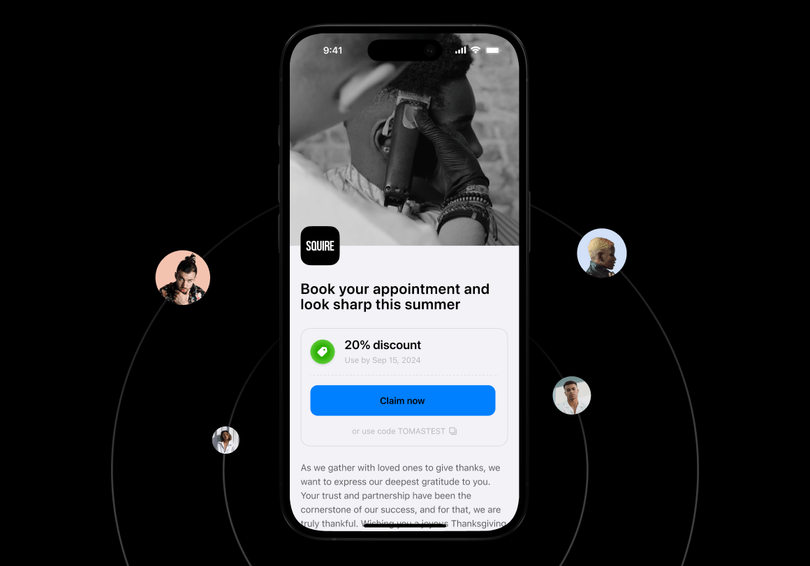
Just Dropped: Engage 2.0 with Smart Rebooking
June 30, 2025
Always searching for new clients? You may need a different approach
January 18, 2024